
A Domain Registry is an organization responsible for managing the registration of domain names under specific Top-Level Domains (TLDs). It maintains the official database of all registered domain names within its TLD and ensures the domain namespace functions properly.
The Role of a Domain Registry
Domain Registries oversee the creation and administration of domain names for their assigned TLDs, which can be generic (gTLD) or country-specific (ccTLD). Their responsibilities include:
- Maintaining a record of domain names: which are available, which are registered, and who owns them.
- Storing registrant details provided by the registrar after a domain is registered.
The Domain Name System (DNS) translates domain names (e.g., example.com) into numerical IP addresses, allowing browsers and servers to locate websites. Registries operate and manage the databases that connect domain names to their corresponding IP addresses.
Managing DNS Records
The registry compiles and uploads all relevant data into a centralized database and publishes Internet Zone files. Domain owner details can be viewed using a WHOIS lookup tool.
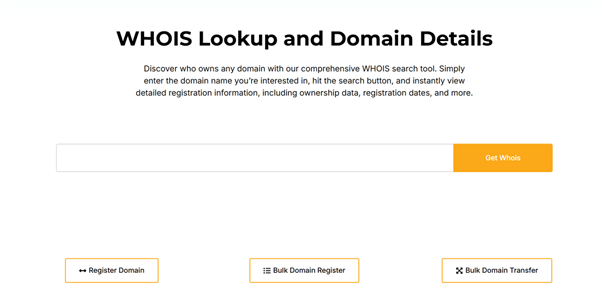
WHOIS and Public Information
Registries typically do not sell domains directly to the public. Instead, they authorize accredited registrars to provide domain registration services. These registrars act as intermediaries, handling registrations, renewals, and management of domains for individuals and organizations.
Disclaimer: Any pricing shown in illustrations is for reference only and does not reflect actual costs. E&OE
Services Provided by Registries
- TLD Management
Each TLD (like .com, .net, .org, or country codes like .za, .uk) is managed by an accredited Domain Registry under the oversight of ICANN (Internet Corporation for Assigned Names and Numbers). - Domain Registration Oversight
Registries control the domain registration process within their TLDs. - Central Database & WHOIS
Registries maintain a database of registered domains, including owner details, contact information, and registration dates. - Policy Enforcement
They implement ICANN’s rules on domain registration, eligibility, and dispute resolution. - Technical Infrastructure
Registries manage the DNS servers that translate domain names into IP addresses for website access. - Registrar Coordination
Registries partner with accredited registrars to enable domain registrations, acting as the technical backbone while registrars handle customer-facing services. - Policy Development
They also participate in policy-making to address evolving trends and challenges in the domain industry, collaborating with registrars, domain owners, and the global internet community.

